

By modernizing its MTA infrastructure and gaining real-time control over traffic shaping, Postmark improved resilience, scalability, and delivery speed to the major mailbox providers
Postmark is a transactional email platform designed primarily for developers and SaaS solutions. Major brands like IKEA, Minecraft, Asana, and Litmus rely on Postmark to send automated emails such as order confirmations, password resets, account verifications, receipts, notifications, and the like. The company’s core value proposition is fast delivery and high inbox placement for system-generated emails.
Postmark was originally created by software developer Wildbit and operated independently for many years. In May 2022, ActiveCampaign acquired Postmark and its DMARC Digests product. The acquisition was intended to combine high-end transactional messaging capabilities to ActiveCampaign’s existing marketing automation and CRM platform. The entire Postmark team joined ActiveCampaign, and the service continued as primarily a standalone product after the acquisition, while retaining the highly regarded Postmark brand.
Challenge: Keeping up with the evolving MailOps environment
For many years Postmark relied on PowerMTA from European digital messaging company Bird as its sending platform. As the MailOps environment evolved over time, however, certain limitations in the PowerMTA platform became increasingly problematic for the Postmark team.
“We’d been running PowerMTA for years, and it served us well. But as our needs evolved, the limitations became harder to work around,” explained Alex Burch, staff engineer at Postmark/ActiveCampaign. “The biggest issue? Traffic management. Our previous setup made it difficult for our deliverability and operations teams to respond in real time when something went sideways, like when a mailbox provider temporarily blocks an IP address. In those moments, you need to be able to back off traffic, reroute, and adjust shaping on the fly. Our old configuration didn't give us that flexibility at the MTA level, which meant we were sometimes limited in how quickly we could resolve delivery issues.”
It’s important to note that transactional email differs from other types of commercial emails — like promotions, offers or updates —in significant ways. Retail deals and promotions are nearly always tied to a certain time window, but it’s usually “this week only” or other loose metric. And they’re mailed in bulk via a list, and usually sent in the wee hours of the morning when traffic patterns are slower.
Transactional messages like password resets, or emails sent in support of multi-factor sign-in processes have immediacy, and are often tied to a necessary human response (“We sent a code to youremail@kumomta.com. It will expire 10 minutes after you request it”). They’re usually generated through API calls and SMTP-based email sending streams initiated through an application or other automated system, so no human is directly involved in the sending of individual transactional messages. Near-instantaneous speed and reliable deliverability are essential to the process, and essential to Postmark’s business model.
“Aside from PowerMTA’s issues, our previous infrastructure was running on aging hardware that was increasingly difficult to maintain,” explained Burch. “Scaling required a lot of manual effort, and customizing behavior to match our specific needs was constrained by the proprietary nature of the platform. We needed something that could grow with us, and that we could shape to fit the way Postmark works, not the other way around. We initiated a search for how best to upgrade our systems, and found there was a lot of buzz in the MailOps community and discussion groups around KumoMTA, and so decided to look into it.”
Solution: An MTA optimized for performance
KumoMTA is an open-source MTA built by a team of email infrastructure veterans for high-volume sending environments. It's written in Rust, released under the Apache 2 license, and designed from the ground up for the kind of work Postmark does. As Burch recounted, “We don't make infrastructure changes based on gut feeling. We tested KumoMTA extensively before fully migrating over, and the results confirmed what we were hoping for.”
According to Burch, the five attributes that made KumoMTA the right fit for Postmark:
- Scalability without limits. KumoMTA runs on modern cloud infrastructure with auto-scaling. No more capacity ceilings tied to specific hardware. We can scale up and down based on what our customers need.
- Full control over traffic shaping. This is the big one. KumoMTA gives our deliverability team granular control over how traffic flows to every major mailbox provider. When Gmail, Yahoo, Microsoft, or Apple need us to adjust our sending patterns, we can respond immediately, not hours later. That means fewer deferred messages and faster inbox delivery for recipients.
- Real-time observability. KumoMTA delivers logs and events back to our application in real time via webhooks. This feeds directly into the delivery data our customers see in the Postmark dashboard and improves how quickly we can diagnose and resolve issues.
- Customization that fits our model. Postmark isn't a typical bulk sender. We run a multi-tenant environment where every customer's reputation matters. KumoMTA's Lua-based configuration lets us tailor behavior precisely to our needs: from how we handle bounces to how we manage IP pools across Streams.
- Open source, open road. With an open-source Apache 2 license and source code on GitHub, KumoMTA gives us full visibility into the technology that powers email delivery. No black boxes, no licensing surprises or huge price increases, and a community of some of the largest senders in the world contributing to make it better.
Results: Enormous speed gains through a more manageable, more reliable foundation
The Postmark team executed the switchover to KumoMTA early in 2026, and quickly realized measurable improvements in core email performance metrics. Average queue time — the period between Postmark accepting a message from a customer’s system and completing the SMTP handoff to the recipient's mail server — improved across every major mailbox provider. Queue time is analogous to message delivery time, so faster queue time = faster delivery. Reductions in inbox delivery times were as high as 41.7%:
- Gmail: ~1.2 seconds with KumoMTA, down from ~2 seconds (40%)
- Yahoo: ~3.2 seconds with KumoMTA, down from ~4.6 seconds (30.4%)
- Microsoft: ~2.8 seconds with KumoMTA, down from ~4.8 seconds (41.7%)
- Apple: ~6.3 seconds with KumoMTA, down from ~8 seconds (21.25%)
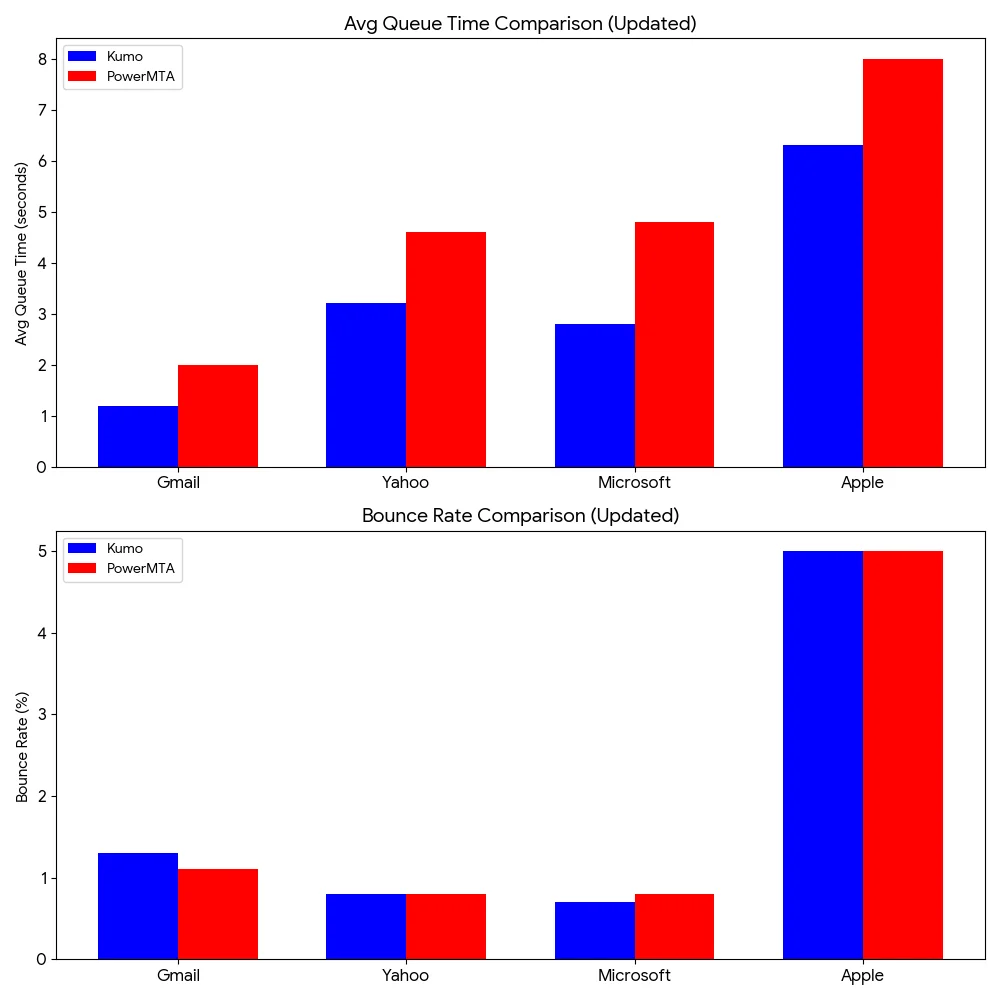 Source: Postmark, 2026
For Postmark customers, queue time improvements translate directly to recipients getting password resets, order confirmations, magic links, and notifications sooner. As Burch put it: “With transactional email, where every second matters, faster delivery directly improves the customer experience. KumoMTA boosted deliverability resilience as well. When a mailbox provider tightens its throttling or temporarily blocks an IP, our team can now adjust traffic in real time. That means fewer disruptions to delivery and faster recovery when issues come up.”
An investment in what matters
Postmark’s MTA infrastructure now runs on modern cloud infrastructure with auto-scaling, comprehensive monitoring, and a full suite of end-to-end tests. This is a meaningful step up in operational reliability from the systems the company had had in place for the past decade.
“At root, this migration project was all about room to grow,” explained Burch. “Adopting KumoMTA wasn’t just about today. It’s about what comes next. KumoMTA's flexibility gives us a foundation to build features and optimizations that weren't possible before. Postmark has always been about one thing: making sure our customers’ emails reach real people fast and reliably. This migration to KumoMTA is a significant investment in that mission.”